
Find Berlin Streets by Address
A Berlin street search works best when the Berlin house number, Berlin street label, and Berlin result date stay together from the first lookup.
A Berlin street directory search works best as a chain. Begin with the physical address, use the parcel system to get a stable identifier, then move to the records keyed by owner, instrument, district, or date. The order matters because a street label can describe a parcel, while a deed may use a lot, unit, plan, or older community name instead.
Keep a note of the exact street choice, house number, parcel or MBL, owner string, mailing city, and the date viewed. That small record turns a loose search into a repeatable address trail.
- Enter the house number and street in Berlin MapXpress, then open Parcel Details, Property Card, Quick Map, or the GIS link.
- Save the MBL or Unique ID. Those fields are more stable than a street spelling when a unit, lot, boundary, or address attribute has changed.
- Open the GIS parcel viewer and inspect visible parcels beside the target. Use Parcel Information and Multi Select for a block view.
- Search the owner as Party 1 or Party 2 in the Berlin SearchIQS index, adding a date range and deed or map description where available.
- Use voter, directory, newspaper, or community-history sources only for the specific dated question they can answer.
Berlin Address Records by Street
Berlin address records split between the Berlin Assessor, Berlin Town Clerk, and state systems, so a Berlin street list is assembled source by source.
Berlin has no county recorder or county assessor. The municipal Town Clerk, Assessor, Revenue Collector, state registrars, and state courts divide the work. The table shows how each street-keyed source fits into the chain and where its limits begin.
| Street-keyed source | Keeper | What it can show | Access |
|---|---|---|---|
| MapXpress property record | Berlin Assessor | Owner, location, mailing address, MBL, sale, value, and building fields | Free public search |
| GIS parcel viewer | Berlin GIS | Parcel polygons, adjacent parcels, layers, and map context | Free viewer |
| Deed and map index | Berlin Town Clerk / SearchIQS | Grantor, grantee, instrument, book/page, legal description, and map entries | Guest index; images vary |
| Tax bill search | Berlin Revenue Collector | Name, property, account, bill, link, tax ID, DBA, and payment filters | Free search; payment fees separate |
| Historical address sections | Libraries and archives | Dated occupant, telephone, business, or household notation | Intermittent runs and appointments |
The parcel or MBL ties the assessor record to the deed trail. A street name helps with a voter or directory search, but it is not proof that the same household occupied every record carrying that label.
MapXpress Fields for Berlin Streets
For Berlin streets, Berlin MapXpress offers the Berlin field names that turn an address clue into a parcel identifier.
The property search has a small, useful field set. Name searches owner strings. House No and Street narrow a physical location. Parcel Id and Unique ID connect a result to the map and later records. The street dropdown includes the current options exposed by the portal, including labels with EB, REAR, and BLDG suffixes.
| Field | Type | Street-search use |
|---|---|---|
| Name | Text | Try a surname, initials, entity, or spelling variant |
| House No | Text | Match the number before comparing owners |
| Street | Dropdown | Choose the portal's exact current label |
| Parcel Id | Text | Use a known hyphenated parcel format |
| Unique ID | Text | Return to one GIS parcel without a name match |
Berlin MapXpress displays the search form that anchors a current street directory result.
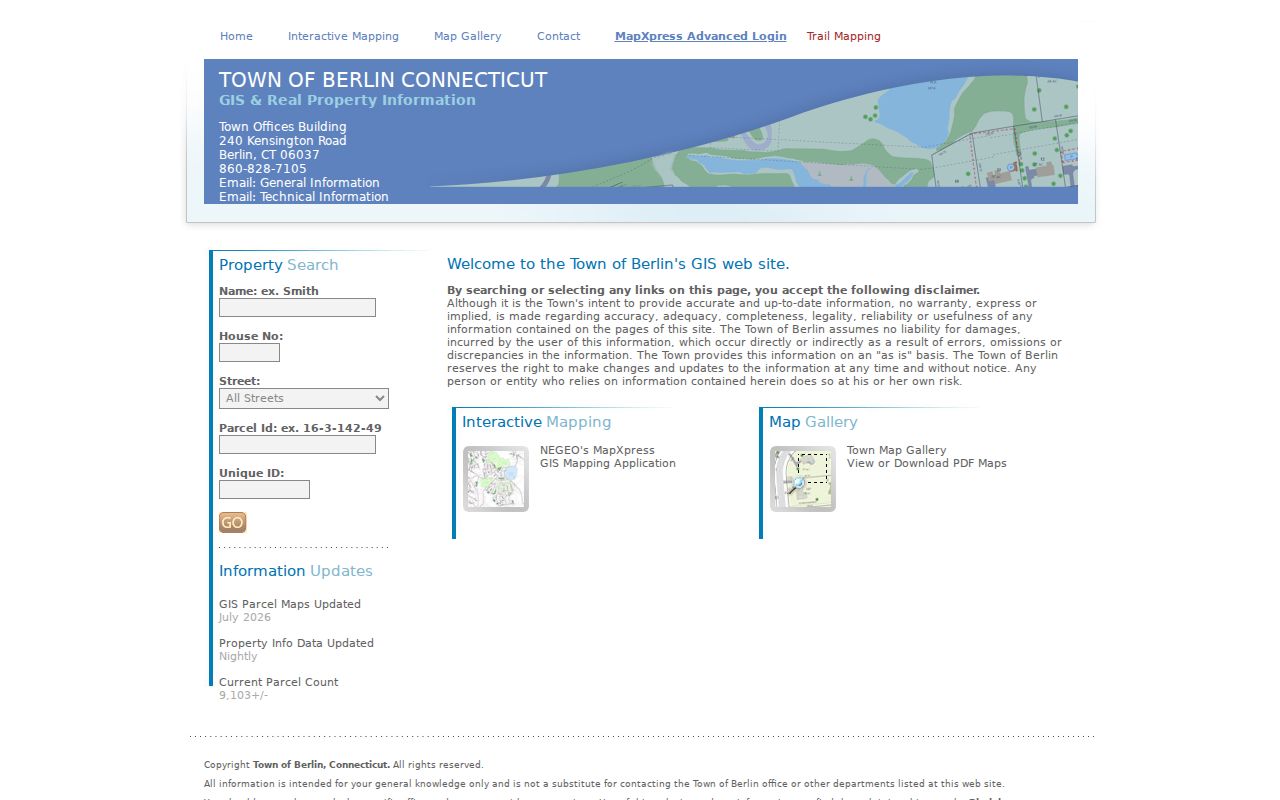
When a name returns several parcels, use the street and number first. When the street label is uncertain, use the parcel identifier and map rather than guessing at a renamed road.
Berlin GIS Works as a Street Browser
The Berlin GIS map lets a Berlin street be read as parcels, layers, and landmarks; the Berlin view remains geographic rather than a household roster.
The Berlin GIS viewer adds the geographic layer that a text search lacks. Search a parcel, open Parcel Information, zoom out, and click visibly adjacent polygons. Multi Select can group several parcels along a street segment. Print preserves the view, while the Legend identifies which overlays are active. The viewer does not document an automatic radius or buffer result, so adjacency must remain a map observation.
Useful layer groups include zoning, historic parcel boundaries, sales layers for 2021 through 2025, aerials from 2004 through 2023, wetlands, FEMA mapping, schools and daycares, water and sewer systems, trails, and open space. A layer adds place context. It does not create a list of people or a relationship between neighbors.
Open the Berlin GIS parcel viewer to compare the target parcel with the surrounding block.
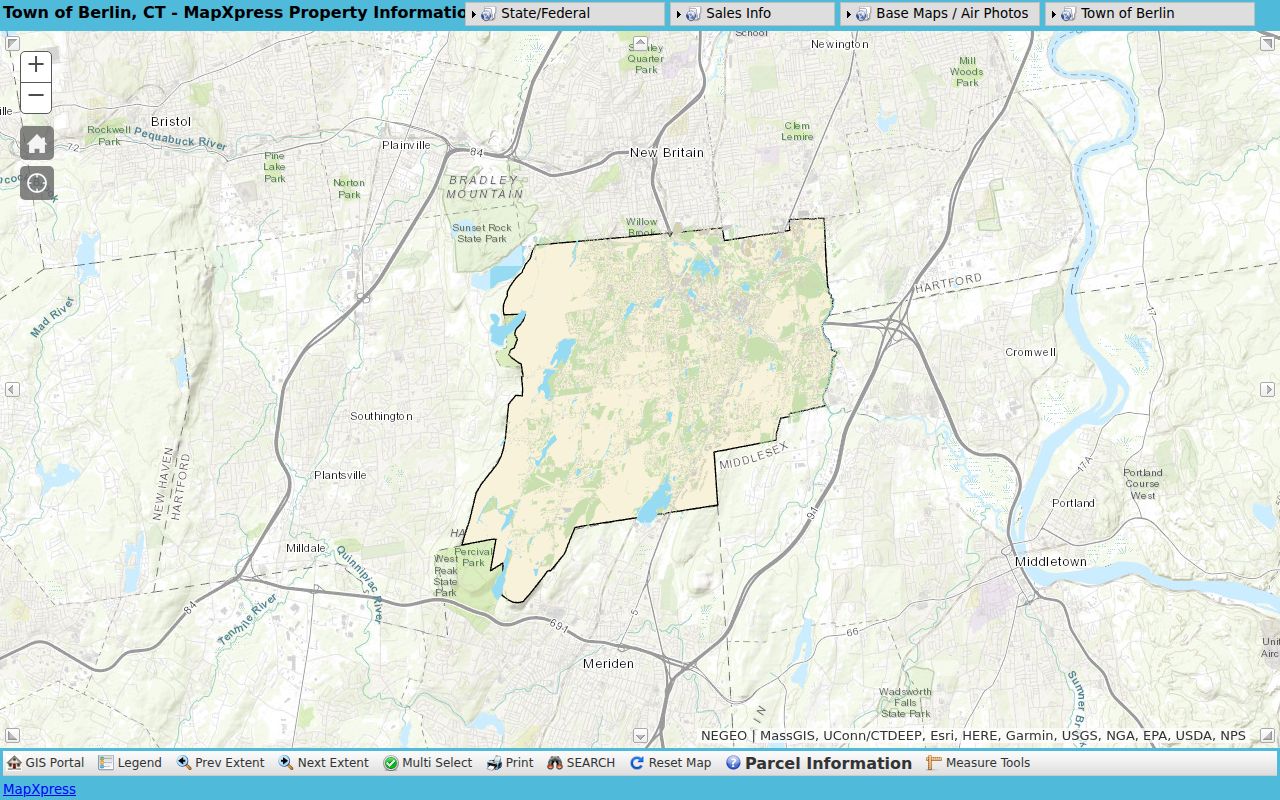
Record the active layer and map date. A parcel outline from an aerial or historic-boundary layer is not the same as a current title record.
Berlin Owner, Situs, and Mailing Fields
A Berlin owner field, Berlin situs line, and Berlin mailing line describe different relationships to the property.
Keep the Berlin owner, Berlin location, Berlin mailing address, and Berlin parcel ID in separate notes.
A street directory becomes clearer when the labels are not blended together. Berlin's ArcGIS parcel service exposes OWNER_NAME, LOCATION, STREET, HOUSE_NO, MAIL_ADDR, MAIL_CITY, MAIL_STATE, and MAIL_ZIP. It also exposes MAP, BLOCK, LOT, UNIT, MBL, and UNIQUE_ID. A condominium unit can therefore have both a street location and a unit-level land identifier.
These terms are short, but they do different work:
- Parcel
- A mapped unit of land or a condominium interest identified by the town's parcel fields.
- Situs address
- The physical location used to place the parcel on a street or map.
- Plat or map
- A recorded or mapped drawing that can connect a lot, unit, boundary, or subdivision to the legal description.
- Criss-cross directory
- An address or street section that lets a reader move from a location to an occupant or name for a particular year.
A parcel owner is not automatically the current occupant. Use the distinction in every Berlin street directory note.
Berlin SearchIQS Deeds Along a Street
Berlin SearchIQS can extend a Berlin street search backward when the Berlin parcel or party name is carried into the land-record index.
SearchIQS indexes Berlin land records from January 3, 1972 to the present, with images listed for that current run. Its local coverage also includes foreclosure registrations from November 4, 2011, maps from March 27, 1945, earlier map indexes back to October 1, 1892, 1956-1971 grantor and grantee index books, and 1949-1971 record-book images. A guest search can reveal an index row, but image viewing or printing may require an account or charge.
Search the current owner as a party, then inspect the recording date, document description, book/page or instrument number, and legal description. A seller's name can lead to the prior deed. If the address is absent from an old instrument, search the MBL, lot, unit, plan, or map reference instead.
Berlin Town Clerk land-record information is the local check for copy rules, older books, and the free property-fraud alert.
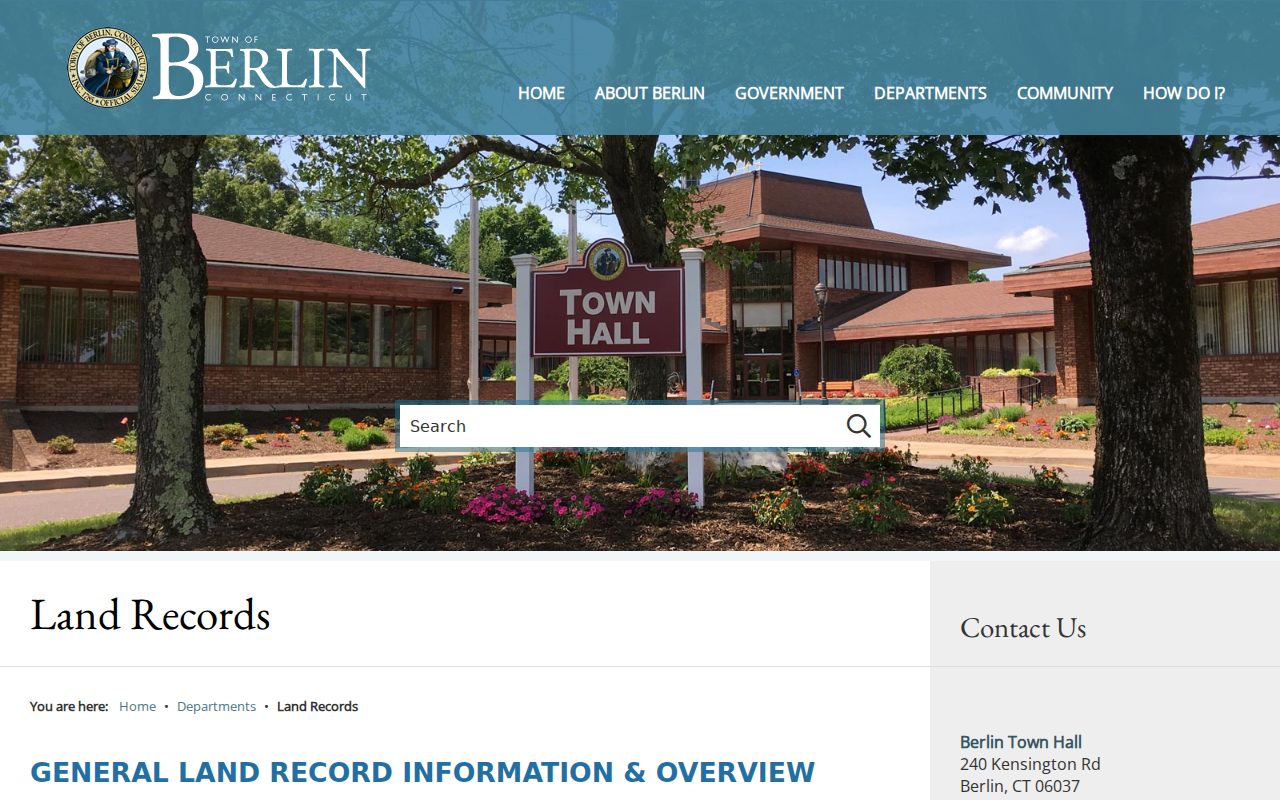
When the online index stops, ask the Town Clerk whether a counter, book, or microfilm route covers the date you need.
Berlin's EB and Rear Street Labels
Older Berlin entries may abbreviate Berlin streets or use an EB, rear, or community label that does not match today's Berlin dropdown.
The MapXpress dropdown records practical search strings such as Berlin St EB, Berlin St Rear, Chestnut Ln EB, Division St EB, Grove St EB, Main St EB, Mill St EB, and Wilcox Ave EB. Other options include building and rear variants. These are observed portal choices, not a formal citywide renaming or renumbering history.
Historical labels add another layer. Berlin, Kensington, East Berlin, Berlin Station, and New Britain appear in different postal, directory, and community records. New Britain remained part of Berlin until 1850. For an old street question, test the label used in the dated source, then bridge it to the current parcel with a map, legal description, or cross-street.
Berlin Tax Bills and Permits by Address
Berlin MyTaxBill and Berlin permit channels can add an address clue, but neither Berlin payment data nor a permit lead proves occupancy.
Berlin's MyTaxBill portal can search by last name or business name, property number, bill number, account number, link number, tax ID, account ID, link ID, or DBA. Filters include All, Due Now, Balance Due, and IRS Payment Records for 2025. The portal is useful for a dated account or property clue, but payment history is not proof of title or occupancy.
CitySquared has handled online permit applications since January 18, 2021. The Building Department also accepts printable applications through Dropbox, mail, or in person. No complete public address-indexed permit-result search was exposed, so a date or permit question may need a request to the department.
Berlin's tax-bill search shows the available account modes and filters.
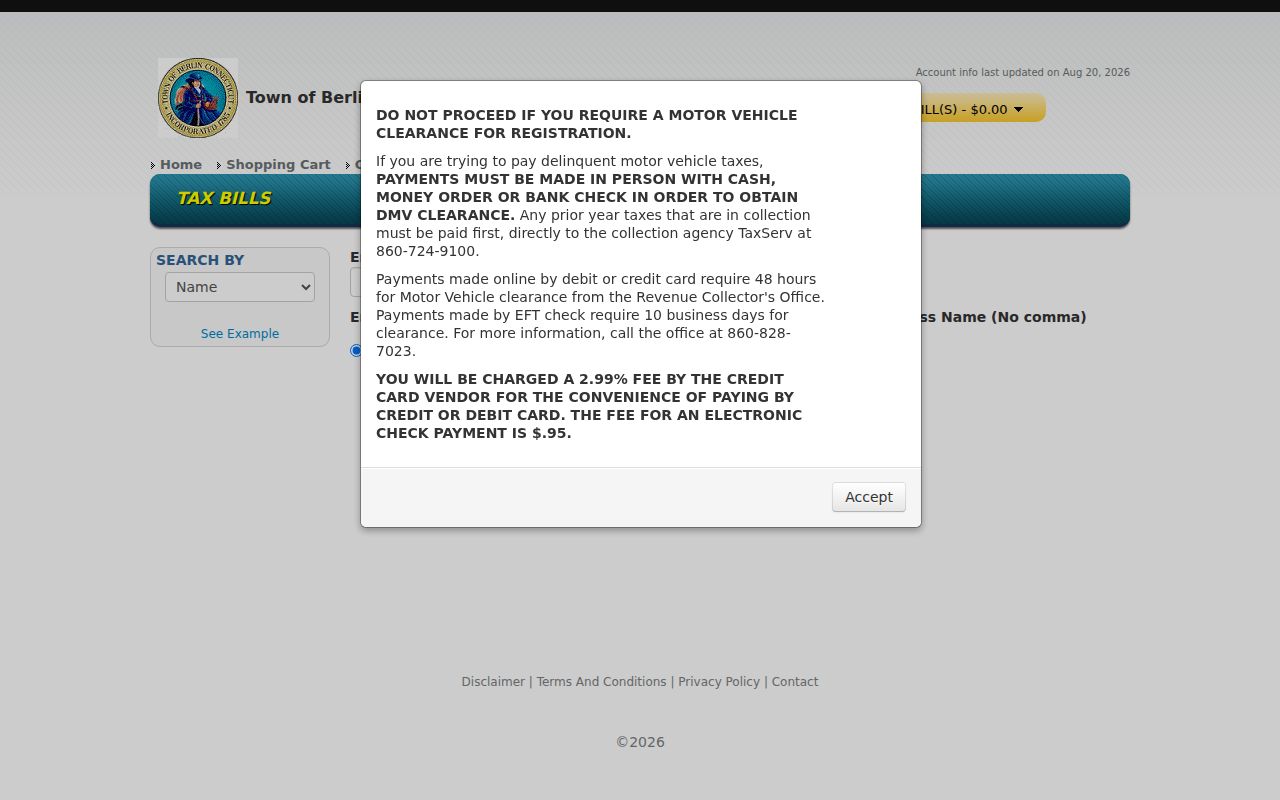
Use the tax record to ask a date question, then verify ownership through the assessor or recorded land instrument.
Reverse Directories Turn Berlin Streets into Names
A Berlin reverse directory changes direction from street to name; Berlin-Peck and archive staff can help test that historical Berlin connection.
Historical address sections can supply the occupant clue that a modern parcel record cannot. NARA identifies Berlin directory years 1914, 1922, and 1930, with regional entries that also include Cromwell and Rocky Hill. A Gale finding aid lists Berlin and Kensington reels for 1954 through 1959. A dated street or numerical section can point to an alphabetic entry, telephone notation, business, spouse, or household abbreviation.
Do not treat the entire historical shelf as a continuous Berlin run. The public Berlin-Peck page does not publish every local directory year or original publisher. Use its catalog and Town Historian appointment route to confirm the volume, title page, and access location. The broader collection method is described on the Berlin city directory page.
What a Berlin Street Directory Omits
A Berlin street directory may omit occupants, protected voters, guests, and newer moves; Berlin parcel and Berlin court records answer different questions.
Public parcel records usually identify an owner and a tax mailing address, not every person who uses the property. DMV address and driving data are restricted. Utility customer records, protected voter addresses, sealed court information, confidential vital files, and private group rosters are not ordinary street-search fields. A deed may use an entity, trust, PO Box, legal description, or old address form.
Lawful use. A Berlin street directory is a research aid for personal and lawful purposes. Do not use parcel, voter, court, or map information to stalk, harass, threaten, or intimidate another person.
If the question shifts from one street to one named person, move to the Berlin resident lookup workflow and keep the record type and date beside the name.
Keep Berlin Street Results Dated
Write the Berlin street, Berlin source, and Berlin lookup date beside every result so an older Berlin entry is not presented as current.
A Berlin street result is easier to audit when the Berlin field, Berlin portal, Berlin date, and Berlin question are recorded together.
MapXpress says property information is updated nightly and parcel maps are labeled July 2026. SearchIQS has its own land-record cutoffs. A directory, census, Sanborn map, tax bill, voter file, and deed each describe a different time slice. Put the source date, portal date, street spelling, parcel ID, and any uncertainty in the research note.
The most reliable by-address result is a careful chain: current parcel, legal identifier, recorded instrument, dated historical clue, and a second source. That chain respects what a Berlin street directory can show without turning a map or owner row into an unsupported claim about a household.